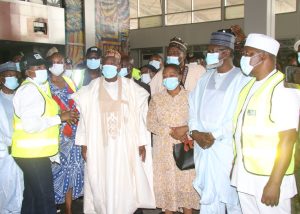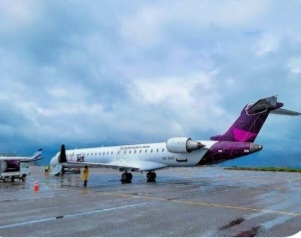


 Nigeria has announced its arrival on global aviation stage with the maiden Nigeria International Airshow, a landmark event hailed by President Bola Ahmed Tinubu and the Minister of Aviation and Aerospace Development, Festus Keyamo, as a defining chapter in the nation’s aviation history.
The event, which positions Nigeria alongside global giants such as Paris, Dubai, Farnborough, and Singapore, showcases the country’s determination to become a leading force in regional and international aviation.
Speaking on behalf of President Tinubu, the Secretary to the Government of the Federation, Senator George Akume, welcomed delegates to the inaugural edition, describing it as a moment that signals Nigeria’s readiness to “soar beyond long-standing limitations” and embrace global aviation leadership.
He emphasised that the Airshow coincides with Nigeria’s celebration of a century of aviation activity, making the milestone even more symbolic. “We stand today not only as participants but as contributors to global aviation progress,” he said.
Festus Keyamo, in a foreword published in the Airshow Magazine, captured the significance of the moment, noting that Nigeria has long aspired to host an event of this magnitude. “For years, the world asked when Nigeria would step forward,” he wrote. “Today, with this Airshow, we present a confident and resounding answer.”
While acknowledging the learning curve that comes with the first edition, the Minister affirmed that Nigeria is taking “small but deliberate steps” toward establishing a globally recognised aviation brand.
The Minister and the President both outlined the substantial progress the sector has made under the current administration. Passenger traffic continues to climb, with 2023 figures rising to 15.89 million.
Projections from the NCAA suggest this number could reach 25.7 million by 2029, generating up to $2.58 billion in annual revenue. This upward trend, they noted, reflects Nigeria’s growing economic activity, expanding air connectivity, and rising consumer confidence.
Massive infrastructure investments form another pillar of the sector’s transformation. The N712 billion redevelopment of Murtala Muhammed Airport in Lagos spearheads a nationwide modernisation effort that includes runway upgrades, terminal improvements, and the expansion of cargo handling infrastructure across major airports.
These investments, Keyamo said, are designed to enhance operational efficiency, boost passenger comfort, and position Nigeria as a preferred transit and logistics hub.
Safety and regulatory compliance have also recorded remarkable progress. President Tinubu highlighted Nigeria’s ascent to first place in Africa for compliance with international aviation standards.
The improvement of the nation’s Cape Town Convention score – from 49.5 per cent to 75.5 per cent – has strengthened aircraft leasing confidence and expanded opportunities for Nigerian airlines.
Keyamo attributed these gains to enhanced NCAA oversight, improved recertification exercises, upgraded Instrument Landing Systems, state-of-the-art surveillance technologies, and stronger airport security architecture aligned with ICAO benchmarks.
The administration’s commitment to reducing capital flight is reflected in its aggressive push for local aircraft Maintenance, Repair and Overhaul (MRO) capacity. Nigeria’s partnerships with Boeing and Cranfield University are paving the way for advanced MRO centres, a development set to drastically cut the over $200 million that leaves the country annually for foreign maintenance checks.
Local operators such as Aero Contractors and XEJet are also establishing new maintenance hubs in Lagos and Abuja, helping to stabilise fleet management across the industry.
International connectivity is expanding as well. Air Peace’s resumption of the Lagos–London route and the reinstatement of Emirates and Uganda Airlines under new Bilateral Air Service Agreements underscore a more robust global engagement strategy.
Nigeria is also strengthening its participation in ICAO, AFCAC, and other international aviation bodies, playing a more assertive role in shaping regional aviation development.
Training and human capital development remain critical areas of focus. The Nigerian College of Aviation Technology (NCAT) has upgraded its simulators and expanded its training programmes to produce a new generation of skilled aviation professionals.
Keyamo also highlighted various PPP-driven initiatives – including cargo cities, MRO facilities, and aviation city developments – that are expected to create jobs and stimulate innovation.
Both leaders reiterated Nigeria’s ambition to become the aviation hub of West and Central Africa. Their vision is anchored on expanding partnerships with regional carriers, attracting Original Equipment Manufacturers (OEMs), and encouraging investment in aerospace technologies and component manufacturing.
President Tinubu noted that the government’s participation in global exhibitions, such as the Dubai Airshow, demonstrates its readiness to collaborate on defence technology and next-generation aircraft systems.
Keyamo described the Nigeria International Airshow as more than a gathering of industry players, calling it “a declaration of intent” that Nigeria is ready to shape the future of African aviation.
He stressed that the event provides a platform for aviation manufacturers, regulators, investors, airlines, and enthusiasts to explore emerging technologies while inspiring the next generation of Nigerian aviators, drone operators, aerospace engineers, and defence innovators.
In their closing remarks, both Tinubu and Keyamo expressed gratitude to the organisers, stakeholders, and aviation agencies who helped bring the maiden Airshow to life.
They called for continued collaboration as Nigeria refines subsequent editions. “With every edition, we will rise higher,” President Tinubu affirmed.
About The Author