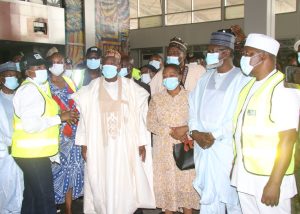

The Nigerian Aviation Handling Company Plc (nahco aviance), in collaboration with the Nigerian Association of Chambers of Commerce, Industry, Mines and Agriculture (NACCIMA), has reaffirmed its commitment to strengthening Nigeria’s non-oil export sector, with a strong focus on empowering Small and Medium Scale Enterprises (SMEs) to access international markets.
This commitment was disclosed on Tuesday in Lagos during a capacity-building forum on export processing for SMEs, jointly hosted by NAHCO and NACCIMA, which brought together exporters, regulators, financial institutions, airlines and logistics providers across the aviation and agro-export value chain.
Speaking at the forum, the Group Executive Director, Business & Business Development, NAHCO Plc, Prince Saheed Lasisi, said the company had strategically aligned its operations with the Federal Government’s ambition of building a one-trillion-dollar economy by 2030, noting that commodity exports remain a critical pillar of that vision.
According to him, achieving the desired scale in non-oil exports would be impossible without the active participation of SMEs, which constitute the backbone of Nigeria’s productive economy.
He stressed that NAHCO recognises the pivotal role SMEs play in national development and is deliberately positioning itself to prepare them for the rigours and requirements of global trade.
Lasisi, however, pointed out that exporting agro-products and other commodities goes beyond production, as it requires strong logistics, quality assurance and efficient handling processes. He explained that NAHCO sits at the centre of the export value chain, serving as a vital link between exporters, airlines and regulatory agencies.
In this capacity, he said the company provides exporters with guidance on cargo handling, product preservation, regulatory compliance, acceptance requirements of international buyers and timely flight connections. He added that these elements are crucial for ensuring Nigerian products remain competitive and acceptable in foreign markets.
The NAHCO executive further highlighted the importance of specialised packaging for perishable and sensitive goods, revealing that the company had established a modern packaging facility within the airport environment with the approval of the Federal Airports Authority of Nigeria (FAAN).
“We have provided a proper packaging facility in the airport area. Our packaging area is in the NAHCO Export Packaging and Processing Centre (NEPPC), the only one of its kind in Nigeria, which commenced operations in July last year. NAHCO also operates an Export Desk that provides dedicated support for exporters,” Lasisi explained.
In his presentation, the Chairman of the NACCIMA Export Group, Kola Awe, Esq., said the association had introduced several initiatives aimed at supporting Micro, Small and Medium Enterprises (MSMEs) to overcome the challenges associated with exporting.
He disclosed that NACCIMA had established the NACCIMA Export Support Centre for MSMEs, noting that many small exporters struggle to scale their businesses due to financial, regulatory and logistical constraints.
According to him, multinational companies often perform better in export markets because they possess the financial strength to absorb shocks and resolve operational challenges, unlike MSMEs.
Awe emphasised the economic significance of small businesses, stating that Nigeria has an estimated 39.6 million MSMEs, although the number has slightly declined in recent years due to economic headwinds. He said MSMEs have a strong presence in agriculture, retail and manufacturing, making them critical to any sustainable export growth strategy.
“The NACCIMA Export Support Centre for MSMEs is a practical export intervention initiative designed to support SMEs and help them transition into successful exporters,” he said.
Earlier, the Director-General of NACCIMA, Engr. Sola Obadimu, while welcoming participants, described the collaboration between NAHCO and NACCIMA as a demonstration of the power of private sector partnerships in driving growth in Nigeria’s agro-export sector.
He noted that MSMEs account for between 80 and 90 per cent of businesses in Nigeria and employ over 80 per cent of the workforce, yet their contribution to export earnings remains disproportionately low. According to him, increased SME participation in exports could significantly alter Nigeria’s economic narrative.
Obadimu identified procedural bottlenecks, inadequate export knowledge, weak export readiness, logistics challenges and limited access to structured support as key barriers confronting SMEs.
He added that although agriculture contributes over 20 per cent of Nigeria’s Gross Domestic Product, agro-based exports still account for only a modest share of export earnings.
Also speaking at the forum, the Managing Director of Polaris Bank, represented by the bank’s Head of Commercial Banking, Mrs. Ladi Ene Garba, stressed the urgency of expanding non-oil exports to reduce Nigeria’s dependence on crude oil.
She noted that oil still accounts for about 90 per cent of Nigeria’s foreign exchange earnings, while non-oil exports contribute less than 10 per cent to overall economic output, exposing the economy to external shocks and volatility in global oil prices.
“Expanding non-oil exports is not an option but a strategic imperative for economic development. A vibrant non-oil export sector will deliver multiple benefits to the Nigerian economy,” she said, adding that Polaris Bank would continue to support SMEs as part of its long-standing commitment to the sector.
Providing an aviation industry perspective, the President of the Aviation Cargo Committee, Mr. Ikechi Uko, highlighted the importance of air logistics in SME growth, observing that many aircraft arrive in Nigeria full but depart largely empty.
According to him, government efforts to organise the air export business would ensure that aircraft leave Nigeria filled with locally produced goods, thereby creating opportunities for SMEs and maximising existing aviation capacity.
In his remarks, the Managing Director and Chief Executive Officer of Burcont Shipping Nigeria Limited, Dr. Akin Oladipupo, commended NAHCO and NACCIMA for convening the forum, describing it as a timely intervention for an industry with vast untapped potential.
He observed that billions of naira remain locked in Nigeria’s farming and agricultural sector due to limited export penetration and called for more coordinated efforts to promote food exports. He expressed confidence that forums such as the NAHCO/NACCIMA engagement would help generate practical solutions to these challenges.
The event attracted key government agencies critical to agro-exports, including the Nigeria Customs Service (NCS), Nigeria Agricultural Quarantine Service (NAQS), National Agency for Food and Drug Administration and Control (NAFDAC), National Drug Law Enforcement Agency (NDLEA), Nigerian Export Promotion Council (NEPC), Federal Produce Inspection Office (FPIS), Federal Competition and Consumer Protection Commission (FCCPC) and FAAN.
Also in attendance were airlines and logistics partners such as Turkish Cargo, Lufthansa, Qatar Airways, Kenya Airways, RwandAir, DHL, Burcont Logistics and the National Association of Government Approved Freight Forwarders (NAGAFF), underscoring the broad industry support for strengthening Nigeria’s air export ecosystem.
About The Author