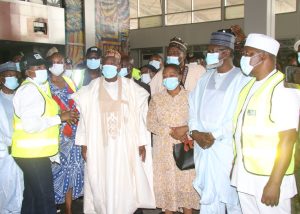






A strategic meeting between United Nigeria Airlines and the Federal Airports Authority of Nigeria (FAAN) has spotlighted critical aviation safety concerns, infrastructure gaps and expansion ambitions within Nigeria’s air transport sector, as both bodies pledged closer collaboration to strengthen operational efficiency and passenger safety.
The engagement, held in Lagos, brought together the airline’s delegation led by Chairman Obiora Okonkwo and FAAN’s team headed by Managing Director/Chief Executive Officer Olubunmi Kuku.
Discussions centred on aviation environmental safety, maintenance infrastructure, airport operating limitations, and long-term growth strategies for domestic carriers.
Professor Okonkwo described the rising incidence of bird strikes as a significant operational and financial burden on airlines, warning that the trend poses safety risks while increasing maintenance costs and disrupting schedules.
He also raised concerns about airports constrained by sunrise-to-sunset operations, noting that limited operating hours and inadequate facilities at Category II airports frequently result in delays and flight rescheduling.
He further pointed to the growing problem of unruly passenger behaviour, urging stronger enforcement of aviation regulations and passenger discipline to ensure safe and orderly operations nationwide.
In addition, the airline formally requested land allocation in Abuja for the construction of a Maintenance, Repair and Overhaul (MRO) facility. Such a facility, according to industry stakeholders, could significantly reduce airlines’ reliance on foreign maintenance bases, cut costs, and enhance Nigeria’s technical aviation capacity.
Responding, Kuku stressed that sustained collaboration between regulators, airport authorities and airlines remains essential for improving safety standards and operational efficiency.
She revealed that FAAN has identified key environmental factors responsible for bird strikes and is implementing mitigation measures, including improved grass control and habitat management around airfields, alongside stronger corporate environmental responsibility policies.
The authority also announced plans to upgrade airfield lighting systems at Category II airports nationwide to support extended operating hours. Specific projects include apron and lighting improvements at Benin Airport and additional lighting enhancements in Jos, initiatives expected to reduce disruptions caused by poor visibility and limited night-time infrastructure.
FAAN pledged stricter enforcement measures against unruly passengers and signalled openness to reviewing United Nigeria Airlines’ Abuja land request, expressing optimism that approval could be fast-tracked to boost local aircraft maintenance capacity.
Commenting after the meeting, Executive Director and Chief Operating Officer Osita Okonkwo emphasised that continuous cooperation between airlines and airport authorities is indispensable for sustainable aviation development. He noted that coordinated planning and joint safety initiatives are vital as Nigeria’s air travel demand steadily expands.
Other members of the airline’s delegation included Director of Administration Linus Awute, Director of Flight Operations Ahmad Mahmoud, Chief Commercial Officer Raphael Uchegbu, and Director of Human Resources Kelechi Violet Asuquo, among other senior officials.
Aviation analysts note that the outcomes of such engagements could shape the trajectory of Nigeria’s aviation industry, particularly as stakeholders push for improved infrastructure, enhanced safety standards and greater domestic technical capability.
The proposed MRO facility, if realised, would mark a major step towards reducing capital flight associated with overseas aircraft maintenance while positioning Nigeria as a regional aviation services hub.
The meeting signals renewed commitment from both the airline and the airport authority to address longstanding operational challenges and jointly pursue reforms aimed at strengthening reliability, safety and growth across the country’s aviation ecosystem.
About The Author