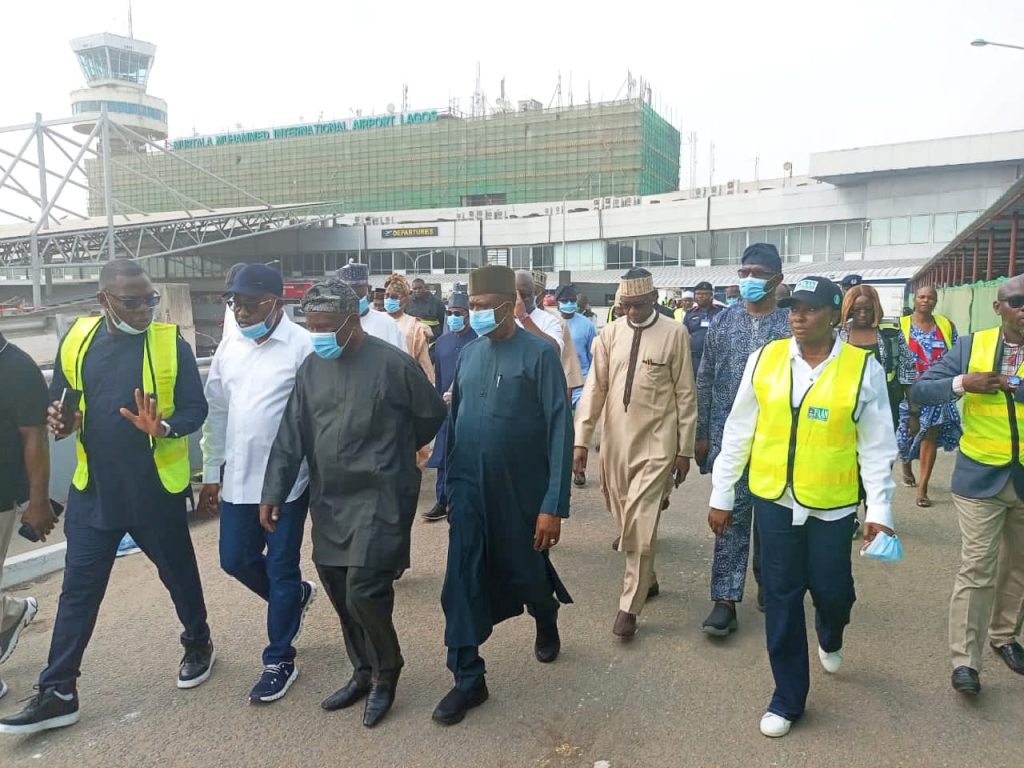
Federal legislators have commended aviation authorities and emergency responders for their swift action following the fire that ravaged part of the old terminal at Murtala Muhammed International Airport, describing the coordinated response as evidence of Nigeria’s renewed emphasis on aviation safety, even as investigators work to establish the cause of the incident.
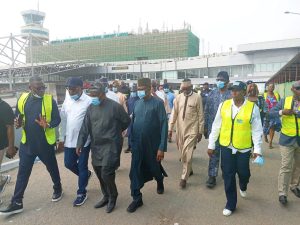
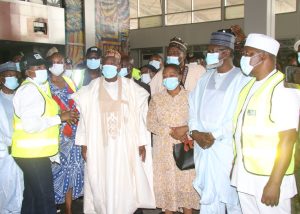
During an inspection visit to Lagos, Chairman of the Senate Committee on Aviation, Abdulfatai Buhari, said members of the National Assembly from both chambers travelled to the airport to conduct a firsthand assessment after concluding official budget defence engagements.
He explained that the visit was intended to evaluate the level of damage and the effectiveness of emergency measures deployed after the blaze broke out earlier in the week.
According to him, the most reassuring outcome was that no lives were lost, a development he described as the foremost priority in any aviation-related incident.
He also praised the rapid operational recovery achieved by agencies, particularly the Federal Airports Authority of Nigeria, noting that diverted international flights were safely handled, including aircraft rerouted to Malabo and Accra.
Despite the disruption, major carriers such as Emirates and Lufthansa were still able to land in Lagos shortly after midnight, a development lawmakers interpreted as proof that contingency protocols functioned effectively.
Buhari cautioned against premature conclusions, emphasising that multiple investigations were underway. He said authorities would refrain from speculation, including suggestions of sabotage, until security agencies and aviation experts completed their analyses and issued formal findings.
The Chairman of the House Committee on Aviation, Abdullahi Garba, echoed this stance, stressing that legislative action would depend on the outcome of the probe. He singled out the airport’s managing director for commendation, stating that stabilising operations within roughly three hours demonstrated strong crisis management and institutional preparedness.
About The Author