
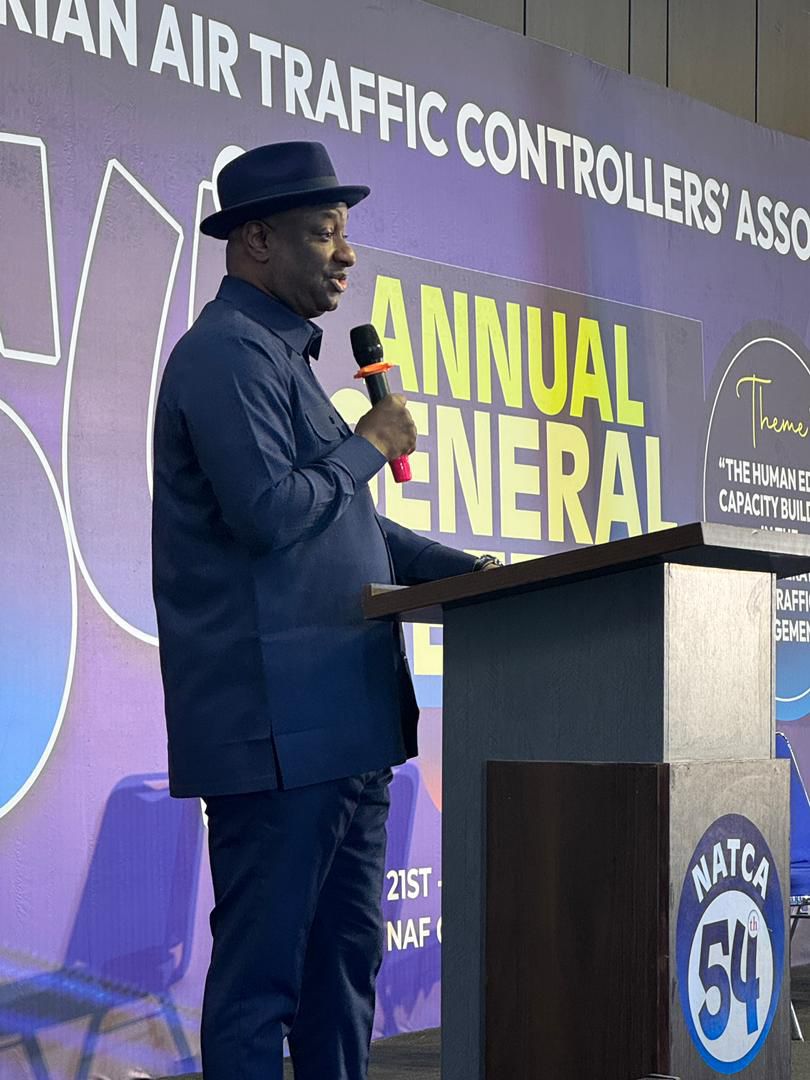



The Federal Government has announced plans to review and increase the retirement age of Air Traffic Controllers (ATCOs) across Nigeria, a move aimed at addressing the deepening manpower shortage and preserving critical expertise within the aviation sector.
The Minister of Aviation and Aerospace Development, Mr Festus Keyamo (SAN), made the disclosure on Tuesday while declaring open the 54th Annual General Meeting (AGM) of the Nigerian Air Traffic Controllers’ Association (NATCA), held at the Nigerian Air Force (NAF) Conference Centre, Abuja.
The two-day conference, themed “The Human Edge: Capacity Building in the Next Generation Air Traffic Management,” drew together key aviation stakeholders, policymakers, and professionals from across the country.
Addressing delegates, Mr Keyamo said the Federal Government recognises the need to retain skilled professionals within the air traffic management system.
He stated that the Ministry would collaborate with relevant agencies to review the retirement age upward, allowing controllers to remain in service longer and transfer their experience to younger colleagues.
“I listened to the President’s speech on the age of retirement of Air Traffic Controllers, and I am convinced that it is something I can take up,” the Minister said. “If pilots can fly up to the age of 65 years, there is no reason Air Traffic Controllers cannot also serve up to 65.”
Describing Air Traffic Controllers as “the apple of the eye of aviation,” Keyamo reaffirmed the government’s commitment to improving their working conditions, noting that the safety of the skies rests on their professionalism and alertness.
“You are in charge of the safety of our skies, and I assure you that this administration will give you the necessary support to function effectively,” he said.
He added that the shortage of controllers in Nigeria’s airspace system had become a pressing issue requiring urgent intervention.
In his welcome address, NATCA President, Mr Edino Ilemona Amos, expressed appreciation for the Minister’s assurance and reiterated the Association’s long-standing call for an upward review of the retirement age from 60 to 65 years.
He explained that manpower depletion had become a significant challenge, driven by a wave of retirements, inter-agency transfers, and the emigration of skilled professionals abroad in search of better opportunities – a trend popularly known as the “Japa” movement.
“If decisive measures are not taken, by 2030, despite expected growth in aviation activities, the Air Traffic Controller workforce could decline sharply, potentially widening the manpower gap by up to 70 per cent,” Amos warned.
He urged the Federal Government to align the controllers’ retirement age with that of pilots and other critical professions, noting that the decision would help stabilise operations and enhance safety oversight in Nigeria’s airspace.
Highlighting NATCA’s achievements in the past year, Mr Amos said over 150 controllers had undergone international training in Performance-Based Navigation (PBN), Controller–Pilot Data Link Communication (CPDLC), On-the-Job Training Instruction (OJTI), Unmanned Aircraft (UA) Fundamentals, UTM Airspace Integration, and Search and Rescue Operations.
Another 300 controllers benefited from the first-ever domestic training programmes introduced by the Nigerian Airspace Management Agency (NAMA), while NATCA organised webinars on Team Resource Management, Safety Scenario Analysis, and Mental Well-being – reaching more than 370 participants across the country.
“Human capacity development remains at the heart of air traffic safety,” Amos said. “While automation and artificial intelligence are reshaping the aviation world, it is still the human intellect, intuition, and judgment that safeguard our skies.”
Mr Amos also highlighted NATCA’s welfare milestones, including the salary adjustment for Air Traffic Controllers in NAMA, which was signed in August 2025 and implemented in September, after years of sustained advocacy.
“This landmark achievement should, in due course, be extended to other agencies housing Air Traffic Controllers, ensuring equity and uniform recognition of our professional value across the aviation sector,” he said.
Additionally, he noted that NAMA had commenced the distribution of operational vehicles to key stations and rolled out secured warm clothing for controllers working in cold operating environments through the Directorate of Air Traffic Services (DATS).
NATCA also intervened in welfare matters by facilitating the payment of death benefits and securing employment for the widow of a deceased colleague, reflecting the Association’s solidarity and compassion.
Amos further reported that NATCA had achieved remarkable visibility on the global stage. Nigeria was elected into four International Federation of Air Traffic Controllers’ Associations (IFATCA) Standing Committees, a first in the country’s history.
In April 2025, NATCA hosted the IFATCA Africa and Middle East Executive Council Meeting in Abuja – the first ever in Nigeria. This was followed by the signing of a Memorandum of Understanding (MoU) with United ATS on 29 May 2025, establishing NATCA’s first industrial partnership and paving the way for a series of workshops, including one held during this year’s AGM.
The Association also launched the Sky Bridge Foundation, a mentorship initiative to inspire and prepare the next generation of aviation professionals in Nigeria.
Despite the progress, the NATCA President acknowledged ongoing challenges, including CNS/ATM infrastructure deficits, which currently stand at about 68 per cent, and the need to finalise the Conditions of Service (COS) negotiations for Air Traffic Controllers.
“It is not enough that we do our best; sometimes we must do what is required,” Amos quoted Winston Churchill, emphasising the need for persistence, collaboration, and visionary leadership to sustain progress in the sector.
In his closing remarks, Minister Keyamo pledged to work closely with the Permanent Secretary, Dr Ibrahim Kana (mni), and other relevant bodies to study NATCA’s proposal and ensure the necessary approvals for the retirement age review.
“We will sit down and carefully study this recommendation,” he said. “Experienced hands are vital for the safety of our skies, and it is only wise that we retain such professionals while grooming the next generation.”
Mr Amos concluded by reaffirming NATCA’s dedication to excellence, unity, and continuous capacity development. He noted that in 2024 alone, Nigerian Air Traffic Controllers successfully managed over 420,000 aircraft movements, a 12 per cent increase from the previous year, despite operating with less than 65 per cent of the required manpower.
“Every safe landing and every smooth departure bears the unseen signature of an Air Traffic Controller,” he said. “This is evidence that excellence, dedication, and teamwork define who we are.”
He urged the government and stakeholders to continue investing in human capital and modernising air navigation infrastructure to ensure Nigeria’s airspace remains one of the safest and most efficient in Africa.
The 54th NATCA AGM continues in Abuja with technical sessions, training workshops, and policy discussions focused on innovation, human resource development, and the future of air traffic management in Nigeria.
About The Author