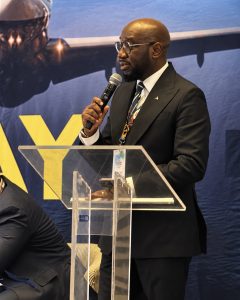


Chief Executive Officer Ibom Air, George Uriesi, has appealed to the Federal Government to help airlines reduce the plethora of fees and charges they are being made to pay, as they are taking a huge turn on Airlines ability to be profitable.
Uriesi made this known while delivering a keynote address on the day two of the just concluded FNAC 2025, with the discussion on Airline Profitability and Cost Optimization.
He noted that airlines in Nigeria are operating in a very difficult environment when compared to their counterparts in other parts of the world with lots of over heads.
He stressed that there are infrastructure limitations, as many of Nigeria’s Airports do not support full utilisation of aircraft.
Uriesi lamented that despite these huge charges or taxes, infrastructural problems airlines are contending with, there is also a current problem in Abuja where Air Traffic Controllers are making airlines burn more fuel.
He disclosed that ” ATCs have decided to default to procedural approach management instead of radar.”
“Abuja is a busy airspace in Nigeria. They keep the aeroplane in the air for longer, there is a lot of communication with so many different aeroplanes doing the capacity waves, which is a safety issue.”
He noted that pilots raising up the issue often, as the flight to Abuja is now long because you have to wait for about 20minutes, while seating in the aircraft before you can use the Runway.
Uriesi however appeal to the Nigeria Airspace Management Agency NAMA to help the airlines use the Radar.
He said “I know you are training ATCs,,but you can’t train ATCs in Abuja during peak all the time.”
“Airlines are suffering, we are paying unnecessarily more”
He maintained that some of these are the things that impact on the ability of Airlines to operate profitably .
On the way forward, Uriesi disclosed that some of the things that can be done to help airlines make profit include.
Cheaper Aircraft financing
Maintaining Aircraft locally, as airlines spend millions of naira to maintain their aircraft outside the country, as its not profitable and often times Nigerian operatives are being scammed.
He also advised airlines to try as much as possible to have more aircraft like 10& 15 in their fleet to enable them make profit.
Also speaking on the Topic Airline Profitability and Cost Optimization,
Chief Executive Officer Aero Contractors Captain Ado Sanusi, also noted that the financial problems Nigerian carriers are faced with is rooted in deep‑seated systemic issues rather than poor airline management alone.
Capt. Sanusi who was a panelist described profitability in Nigeria’s airspace as “extremely difficult” because every component of the ecosystem contributes to the losses airlines incur.
Sanusi who commended the critical safety oversight role of regulators, noted that excessive regulatory charges, ageing infrastructure, gaps in weather reporting and operational bottlenecks across agencies – including FAAN, the Nigerian Civil Aviation Authority (NCAA), the Nigerian Airspace Management Agency (NAMA) and the Nigerian Meteorological Agency (NIMET) – are some of the problems airlines contend with.
He said “Daily delays triggered by infrastructural deficiencies, inaccurate weather reports that force mid‑flight returns, and peak‑hour airspace restrictions caused by training schedules all eat into our profit,” adding that “no airline wants to delay or cancel a flight. What we sell is speed. When we delay, it harms us first.”
He warned that blaming airlines for delays, especially in discussions about penalty regimes, could push carriers toward unsafe decisions.
“Determining the cause of delays must remain the exclusive responsibility of the NCAA,” he asserted, adding that punitive legislative measures could pressure airlines into compromising safety to avoid sanctions.
Sanusi however called for “genuine, long‑term reform” of the aviation sector, dismissing existing roadmaps and interventions as fragmented and short‑lived.
“Nigeria cannot achieve sustainable aviation growth without a 20‑ to 30‑year structural overhaul that aligns all aviation agencies with efficiency, modernisation and economic sustainability,” he said.
Capt. Sanusi while also commenting on technology highlighted Aero Contractors’ aggressive digital transformation, from paperless maintenance to AI‑driven tools and electronic flight packs.
He noted that they are hindered by the slow pace of regulatory approvals: “You can only be as efficient as the system you operate in. Even simple tools like digital manuals require regulatory acceptance. The future is bright, but the regulator must be ready.”
While concluding, Sanusi appealled for balanced taxation and supportive policies, stressing that airlines are not seeking exemptions but a unified, sustainable tax regime that does not “tax operators to death.
Capt. Sanusi while praising the few carriers that have managed to remain profitable, as they are “evidence that Nigerian airlines can thrive if the system stops working against them.”
Managing Director, Federal Airports Authority of Nigeria FAAN Olubunmi Kuku in a brief response to the panel session noted that they get feedback, and understand the challenges the airlines are facing in the airport environment.
She however stated that ” This is a sectoral issue, and what that means is that , as the airlines are having issues, so are the regulators and agencies.”
She described as unfortunate, as alot of these issues taking the sector back, should have been fixed before now.
About The Author