
The Nigeria Civil Aviation Authority (NCAA) has cautioned the House of Representatives against reducing its statutory share of the five per cent Ticket Sales Charge (TSC) and Cargo Sales Charge (CSC), warning that such a move could weaken Nigeria’s aviation safety oversight system and reverse gains recorded in compliance with international safety standards.
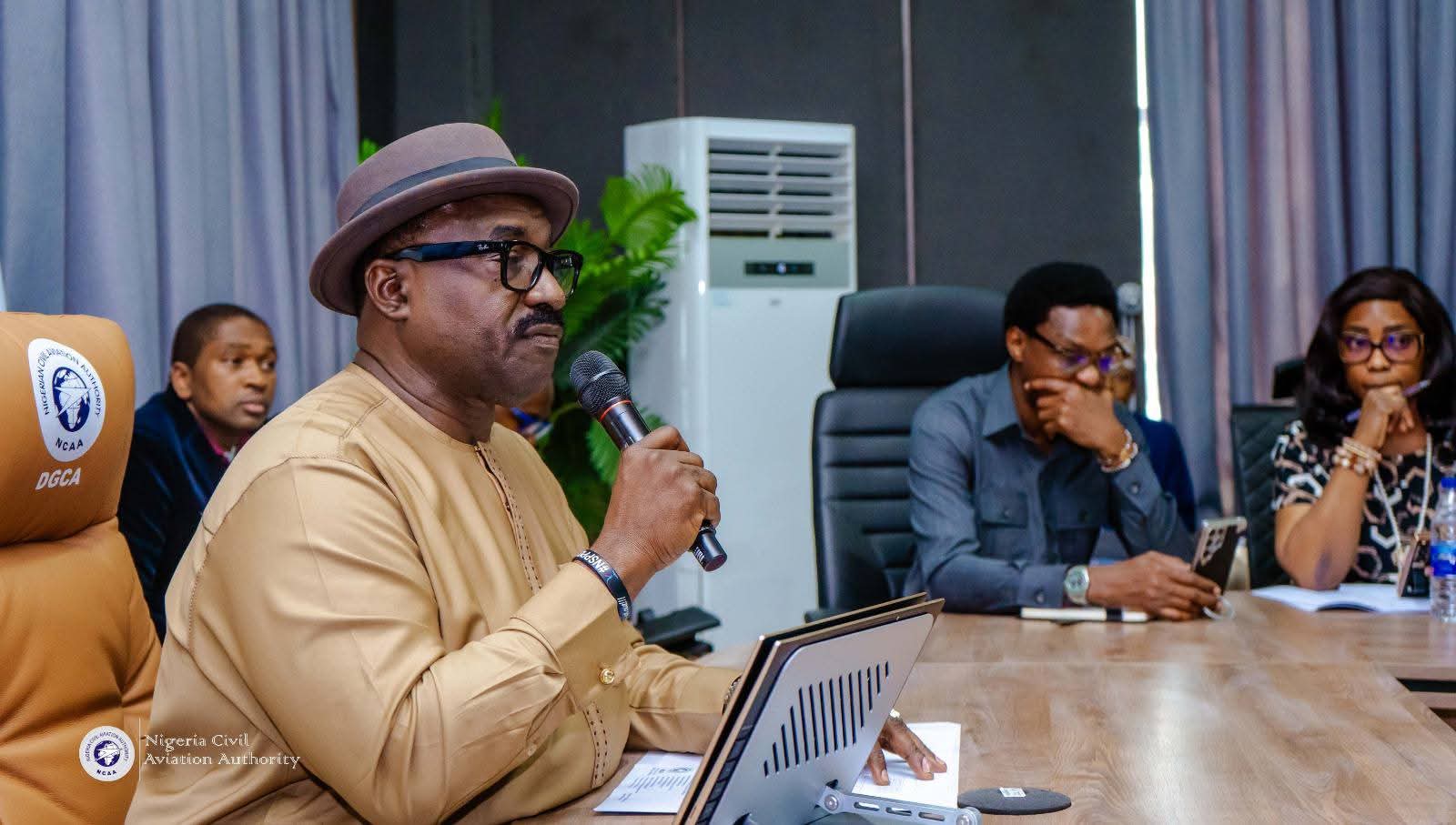
The Director-General of Civil Aviation, Capt. Chris Najomo, made the appeal during the House Committee on Aviation’s public hearing in Abuja on Wednesday on the proposed review of the allocation formula for the TSC and CSC, insisting that while the Nigerian Airspace Management Agency (NAMA) requires sustainable funding, any redistribution should not come at the expense of the country’s independent aviation regulator.
The hearing marked the latest chapter in the long-running debate over the sharing of aviation revenues among the industry’s agencies. For years, NAMA has argued that its responsibilities in managing Nigeria’s airspace, maintaining communication, navigation and surveillance facilities, and upgrading critical infrastructure require a larger share of the TSC.
The NCAA, however, maintains that the levy was primarily designed to sustain the country’s safety oversight functions and should not be diverted from its original purpose.
Addressing lawmakers, Najomo stressed that the issue before the committee was much broader than revenue allocation.
“This presentation is, therefore, not about whether NAMA deserves adequate funding; as it certainly does. Rather, it is about ensuring that the funding of Nigeria’s aviation institutions remains consistent with international standards and does not weaken the Authority responsible for regulating the entire aviation industry,” he said.
He explained that unlike operational aviation agencies, the NCAA performs sovereign regulatory functions and exists solely to ensure that all aviation organisations operating in Nigeria comply with national regulations and the Standards and Recommended Practices (SARPs) of the International Civil Aviation Organisation (ICAO).
According to him, the Authority regulates airlines, airports, aerodromes, Approved Maintenance Organisations, Approved Training Organisations, aviation personnel, ground handling companies and even NAMA itself.
“The Authority is, therefore, the independent regulator upon which the safety of Nigeria’s civil aviation system depends. Simply put, NCAA was established to perform sovereign regulatory functions in the public interest.
“Consequently, the cost of discharging these responsibilities cannot reasonably be recovered solely from the operators it regulates. This was one of the fundamental reasons why a dedicated Ticket Sales Charge and Cargo Sales Charge funding mechanism was established, consistent with ICAO’s long-standing policy that the cost of safety regulation should be supported by the aviation community.”
Najomo noted that beyond domestic regulation, the NCAA also finances Nigeria’s statutory contributions to international aviation organisations, including ICAO, the Banjul Accord Group Aviation Safety Oversight Organisation (BAGASOO) and the African Civil Aviation Commission (AFCAC).
He said these obligations are responsibilities of the Nigerian State but are funded from the Authority’s internally generated resources.
The NCAA Director-General told the committee that although Nigeria recently achieved one of its strongest safety oversight performances, the country’s biggest weakness remained the financing of the safety regulator.
He disclosed that Nigeria attained an Effective Implementation (EI) score of 91.3 per cent during ICAO’s recent Coordinated Validation Mission (ICVM), placing the country among Africa’s leading performers in aviation safety oversight.
However, he revealed that Nigeria recorded only a 50 per cent score in the area assessing whether sufficient financial resources are available to support the State Safety Oversight System.
“We are pleased that Nigeria achieved an Effective Implementation score of 91.3 per cent, reflecting the collective efforts of Government and all aviation stakeholders. However, the assessment also identified a significant area of concern. Nigeria recorded its lowest Effective Implementation score, of only 50 per cent, in the area of financial resources supporting the State Safety Oversight System.
“It is therefore respectfully submitted that reducing the Authority’s principal statutory source of funding at this time would amount to legislating against the very deficiency that ICAO has identified for corrective action.”
Najomo also referred lawmakers to ICAO’s 2026–2028 Global Aviation Safety Plan, which identifies inadequate funding for national safety oversight authorities as the foremost organisational challenge facing global aviation.
He pointed out that ICAO found the worldwide average score for funding safety regulators to be only 67.57 per cent, a level it considered unsatisfactory and one requiring urgent improvement.
“Against this background, Nigeria’s own score of only 50 per cent in this same critical area clearly demonstrates that the financial capacity of the NCAA requires strengthening rather than further reduction.”
The NCAA boss warned that financial constraints were already affecting the Authority’s ability to discharge its statutory responsibilities. According to him, the regulator has struggled to retain highly qualified inspectors because airlines, maintenance organisations, aircraft manufacturers and foreign civil aviation authorities offer significantly better remuneration.
He noted that although the NCAA’s Conditions of Service had been reviewed, the approved package was considerably lower than what had originally been proposed, while implementation had also been limited by funding shortages.
Najomo said inadequate funding had resulted in outstanding inspector duty tour allowances, reduced surveillance activities, delayed certification programmes and constrained recurrent technical training.
He stressed that aviation safety depends on competent inspectors carrying out continuous oversight rather than merely having regulations on paper.
“Aircraft do not inspect themselves. Airlines do not regulate themselves. Air Navigation Service Providers do not oversight themselves. Every certification, every surveillance inspection and every regulatory approval depends upon competent and experienced aviation inspectors.”
He warned that any further reduction in the Authority’s statutory funding could compromise Nigeria’s ability to sustain effective oversight of airlines, airports, maintenance organisations and other aviation service providers.
Seeking to demonstrate why the proposed redistribution was unnecessary, Najomo argued that NAMA already enjoys numerous statutory sources of commercial income.
He listed 16 separate revenue streams available to the agency, including international overflight charges, domestic en-route charges, terminal navigation charges, calibration services, aeronautical information sales, obstacle evaluation fees, telecommunications services, consultancy services, aerial operation charges and property rentals.
According to him, these commercial revenues contribute approximately 75 per cent of NAMA’s total earnings, while the TSC accounts for only about 25 per cent. By comparison, he said the TSC contributes roughly 83 per cent of the NCAA’s total revenue, with regulatory fees accounting for the remaining 17 per cent.
“It is clear that a further reduction in the NCAA’s statutory allocation would therefore have a disproportionately greater impact on the financial sustainability of Nigeria’s Safety Oversight Authority than on the operational funding of NAMA.”
He further argued that even allocating the entire TSC to NAMA would still not resolve the agency’s long-term funding requirements.
Najomo devoted a substantial part of his presentation to explaining ICAO’s policies on financing aviation institutions. He cited ICAO Documents 9082, 9161, 9734 and the 2026–2028 Global Aviation Safety Plan, saying they collectively distinguish between the funding models for safety regulators and air navigation service providers.
According to him, ICAO expects Air Navigation Service Providers to recover their operational costs from aircraft operators through user charges, while Civil Aviation Authorities should enjoy stable funding to enable them to discharge their sovereign regulatory responsibilities independently.
“NAMA, therefore, should not be collecting any share of the TSC because TSC comes from passengers. The users of NAMA’s services are not the passengers but, rather, the aircraft operators.”
He added that ICAO policy also permits the cost of regulatory oversight provided by the NCAA to be incorporated into NAMA’s own charging structure, enabling the regulator to be funded indirectly through the agency’s commercial operations if necessary.
Najomo appealed to lawmakers to restore the NCAA’s share of the TSC to 65 per cent, describing the request as a return to the original funding arrangement established when the NCAA and NAMA became separate entities in 1999.
“The Authority respectfully requests that this honourable committee champions the return to the original vision that drove the establishment of the NCAA and NAMA in 1999. We submit that NCAA’s allocation of the five per cent Ticket Sales Charge be restored to 65 per cent to overcome the deficiencies identified by ICAO at its last audit and bring Nigeria in line with global best funding practices.”
He emphasised that the Authority was not opposed to improved funding for NAMA but believed such support should come through optimisation of the agency’s commercial revenue streams, greater operational efficiency and targeted Federal Government investment in strategic infrastructure projects.
The NCAA’s presentation follows similar submissions by NAMA and other aviation stakeholders before the House Committee. NAMA has argued that modernising Nigeria’s ageing air navigation infrastructure requires greater financial support, while airline operators and several industry groups have maintained that any review of the TSC must remain consistent with ICAO’s internationally accepted funding principles.
The outcome of the National Assembly’s review is expected to shape the future financing of Nigeria’s aviation agencies, particularly as the country seeks to sustain the improved safety oversight rating it recently achieved during ICAO’s validation exercise.
About The Author