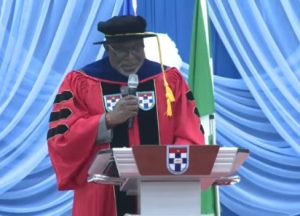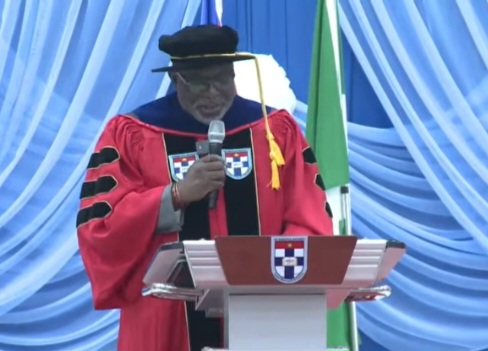
Afe Babalola University, Ado-Ekiti (ABUAD), has conferred an Honorary Doctor of Letters (D.Litt) degree on the Executive Chairman of United Nigeria Airlines, Prof. Obiora Okonkwo, in recognition of his contributions to education and national development.
The award was presented during the university’s 14th convocation ceremony held on Wednesday in Ado-Ekiti, Ekiti State.
The recognition came as the Governor of Ekiti State, Abiodun Oyebanji, and the Ooni of Ife, Oba Adeyeye Enitan Ogunwusi, Ojaja II, commended United Nigeria Airlines for sustaining its flight operations to the state, describing the service as important to improving connectivity and easing travel for residents and visitors.
Oyebanji specifically acknowledged the airline’s contributions to community development through its corporate social responsibility initiatives, citing the donation of a primary healthcare centre and a solar-powered borehole to Aso-Ayegunle community.
The governor disclosed that he had commissioned the facilities a day before the convocation ceremony, adding that they had been handed over to the Ekiti State Ministry of Health and were already being used.
The project, he said, reflected the airline’s commitment to supporting communities beyond its core business of air transportation.
The Ooni of Ife also praised the airline for maintaining regular flight services to Ekiti, noting that its operations had made travelling into and out of the state considerably easier.
He observed that United Nigeria Airlines was currently the only carrier operating flights to Ekiti from both Abuja and Lagos, underscoring its importance to the state’s air connectivity.
The commendations highlight the airline’s growing role in supporting Ekiti’s accessibility, particularly for business travellers, government officials, tourists and other passengers who depend on air transport to move between the state and major Nigerian cities.
Beyond the recognition of his contributions to the aviation industry, Okonkwo’s honorary degree followed an academic engagement in which he called for a fundamental overhaul of Nigeria’s education system to promote practical skills, entrepreneurship, ethical values and national development.
At the university’s 14th convocation lecture on Tuesday, the airline chairman delivered a paper titled, “Functional Education and the Nigerian Project: Strategic Human Capital Development for National Renewal.”
The lecture, delivered at the university’s Alfa Begore Hall, examined the need to reposition education as a tool for developing the skills, knowledge and values required to drive economic growth and address the country’s development challenges.
Okonkwo argued that although functional education had featured prominently in government policies, university programmes and employers’ expectations, insufficient attention had been paid to defining what makes education genuinely functional.
He said education should be assessed by its ability to equip learners with relevant competencies, prepare them for employment, promote entrepreneurship and enable them to contribute meaningfully to economic and social transformation.
According to him, Nigeria needs an education system that aligns its curricula with national economic priorities, technological developments and labour market requirements.
He maintained that universities must move beyond the traditional emphasis on theoretical knowledge to provide students with practical experience, encourage innovation and prepare them to develop solutions to societal problems.
He identified agriculture, engineering, medicine, business, law and the sciences as disciplines requiring stronger practical training, research and entrepreneurship programmes.
The United Nigeria Airlines chairman also stressed that technical competence alone would not guarantee sustainable national development without a strong foundation of moral values.
“Human capital without moral capital cannot sustain national development,” he said.
He identified integrity, discipline, patriotism, leadership, accountability, industry, compassion and humanity as values that tertiary institutions should deliberately cultivate among students.
Drawing on the works of Francis Fukuyama and Douglass North, Okonkwo linked trust, ethical conduct and strong institutions to national competitiveness, arguing that investors are more likely to operate in environments where contracts are respected and accountability is upheld.
The lecture attracted commendation from the founder of ABUAD, Aare Afe Babalola, a Senior Advocate of Nigeria (SAN), who described it as one of the most brilliant lectures he had heard.
Babalola said the recommendations presented by Okonkwo could provide a roadmap for reforming Nigeria’s education sector and announced plans to forward a copy of the lecture to the National Universities Commission (NUC), the Federal Ministry of Education and President Bola Tinubu for consideration.
He said the lecture’s emphasis on curriculum reform reinforced the need for Nigeria to reassess how universities prepare students for the future.
“We cannot teach here what we are going to become in the future without considering the curriculum,” Babalola said.
He also expressed concern over the proliferation of universities that, in his assessment, lacked adequate facilities and the standards required to deliver quality education.
The university founder called for stricter scrutiny of institutions seeking approval to operate, recalling a period when NUC officials physically inspected facilities before granting authorisation.
He suggested that institutional readiness, infrastructure and quality assurance should receive greater attention in decisions concerning the establishment and operation of universities.
Babalola’s pledge to circulate Okonkwo’s lecture to key government institutions and the President raised the prospect of its recommendations contributing to broader discussions on education policy and national development.
Former NUC Executive Secretary and Chairman of the Nigerian Universities Ranking Advisory Committee, Prof. Peter Okebukola, also commended the lecturer, saying he had covered the essential attributes of a functionally educated person.
Similarly, ABUAD Vice-Chancellor, Prof. Smaranda Olarinde, described the lecture as an important platform for intellectual engagement on issues affecting the university, Nigeria and humanity.
The honorary degree and the commendations from Ekiti’s political and traditional leaders place Okonkwo’s aviation leadership alongside his advocacy for education reform and community development.
For United Nigeria Airlines, the recognition also coincides with renewed attention to the importance of sustained air connectivity to Ekiti and the role of private-sector investment in supporting essential community services.
About The Author