….. Cautions Nigeria Against Losing Business to Neighbours
Aero Contractors has urged the Federal Government to place aviation at the centre of its economic development agenda, warning that Nigeria could lose critical jobs, investments and aviation business to neighbouring countries unless urgent and strategic measures are taken to strengthen the sector.
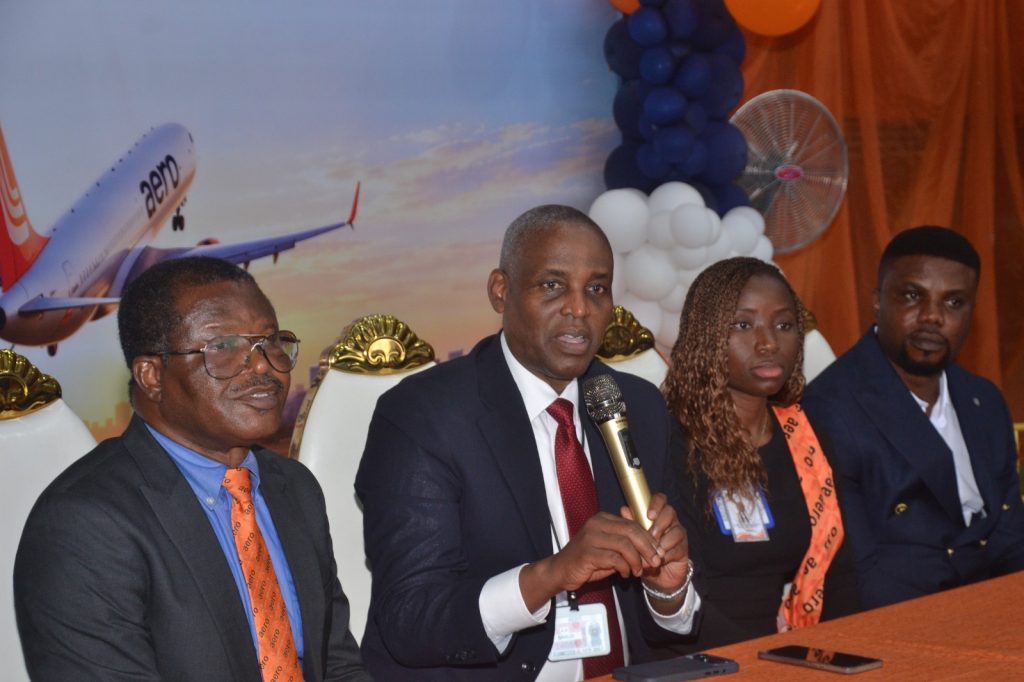
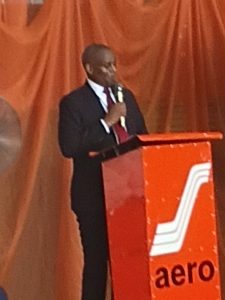
The Chief Executive Officer and Accountable Manager of Aero Contractors, Captain Ado Sanusi, made the call while delivering the keynote address at the airline’s 67th anniversary celebration in Lagos, where he reflected on the company’s long history, its survival through years of turbulence and the challenges confronting Nigeria’s aviation industry.
Speaking under the anniversary theme, “Going the Extra Mile”, Sanusi said Aero Contractors’ 67-year journey was not simply a story of longevity but one of determination and resilience in the face of extraordinary difficulties.
He recalled that the airline, which began operations in 1959, had endured periods of grounded aircraft, empty hangars, unpaid workers and uncertainty over its future, yet managed to remain in operation.
“I did not come here today merely to cut a cake. I came to tell you a story of resilience,” he said.
“We have grounded fleets and empty hangars and still, we flew. We have gone months without a single aircraft in the sky, and still, we flew. We have buried colleagues, gone without pay, and watched the world write us off, and still, we flew.”
For Sanusi, that survival was not the result of luck but the product of the determination of generations of employees who refused to abandon the airline.
“That is not luck. That is not chance. That is the quiet, stubborn dedication of the men and women of Aero Contractors,” he said, paying tribute to engineers, pilots, cabin crew, ground personnel and other support staff.
He said some engineers remained at work long after their shifts, while pilots kept their licences current even during periods when there were no aircraft available for them to fly.
Sanusi said the company’s history was deeply intertwined with Nigeria’s economic development.
Aero Contractors started as a charter and crop-spraying operator before becoming an important aviation service provider to the oil and gas industry.
It entered scheduled passenger operations in 2000 and later expanded into rotary-wing operations, pilot and engineering training, aircraft maintenance and repair.
The airline, he noted, eventually transformed from an organisation operating under foreign technical management into a fully Nigerian-owned aviation institution.
One of its most significant achievements, according to Sanusi, came on January 4, 2018, when its engineers completed a C-check on a Boeing 737 at its own hangar.
He described the accomplishment as Nigeria’s first indigenous Boeing 737 C-check after 14 years without a Nigerian airline carrying out such a check, adding that it was also the first of its kind in West and Central Africa.
Today, he said, Aero Contractors operates across several segments of the aviation value chain, including scheduled and charter services, rotary-wing operations, aircraft maintenance and repair, and pilot training.
Its MRO facility, he added, has also expanded its reach beyond Nigeria by providing services to airlines in other West African countries.
The airline’s survival, however, was not achieved without external intervention.
Sanusi acknowledged the role of the Asset Management Corporation of Nigeria (AMCON), which intervened in 2016 when the airline’s financial fortunes were at their lowest point.
According to him, AMCON’s decision to take a majority stake gave Aero Contractors “a second chance at life”.
He also praised AMCON Receiver/Manager, Senator Adeniyi Ayodele Adegbonmire, SAN, for providing leadership during some of the airline’s most challenging years.
The CEO said the airline’s turnaround was now reflected in its financial performance, noting that its operating margin had improved dramatically from minus 134 per cent in 2022 to a positive operating margin by 2025.
Sanusi argued that the recovery demonstrated why the airline’s 67-year legacy should not be allowed to disappear.
“Sixty-seven years is not a number, it is a living memory, carried by every Nigerian who learned to trust the skies because of us, and by every young Engineer and Pilot who cut their teeth in our hangars and cockpits,” he said.
He subsequently made a strong appeal to the Federal Government to treat Aero Contractors as a strategic national asset.
“I stand before Your Excellency the Minister today, and I say, respectfully but firmly: Aero Contractors is not merely an Airline. It is a National Treasure,” Sanusi declared.
“I humbly appeal that it be recognised, protected, and positioned as such, to serve this nation for the next sixty-seven years, and beyond.”
Beyond the airline’s anniversary, however, Sanusi used the occasion to raise wider concerns about the direction of Nigeria’s aviation industry.
He acknowledged the investments of the President Bola Tinubu administration in infrastructure, particularly the renovation and improvement of Murtala Muhammed International Airport, Lagos.
But he questioned why aviation appeared to have received less strategic attention than other sectors under the administration’s Renewed Hope agenda.
“Mr President, I must respectfully ask: Where is Aviation in the Renewed Hope agenda?” he asked.
According to him, aviation should be regarded as an economic growth engine rather than merely another transportation sector.
“Aviation is not simply a mode of transport,” he said, pointing to countries in the Gulf, East Africa and elsewhere in Africa where aviation has been deliberately deployed to promote tourism, trade, employment and foreign investment.
Sanusi warned that Nigeria’s delay in developing a stronger aviation strategy could have serious consequences for the country’s competitiveness.
He drew attention to the emergence of a new mega-airport and major maintenance hub “just across our border”, which he said was being deliberately developed to serve the Nigerian market.
“Even now, a new mega-airport and a major maintenance hub are rising just across our border, a few minutes’ flight from Lagos, built, quite deliberately, to serve the Nigerian market,” he said.
The implication, he warned, was that Nigeria could eventually export not only passengers but also aviation-related investment and employment to other countries.
“If we do not respond strategically and soon, we risk our airports becoming ghost airports, our hangars falling silent, and our jobs and investment flying quietly across the border, using our own population as the prize,” he said.
He therefore called for a comprehensive national aviation strategy that would place the industry alongside roads, rail and power in the government’s economic development priorities.
“Mr President, Honourable Minister: we are respectfully asking for a Renewed Hope for Aviation, a deliberate, strategic national focus on this sector, alongside roads, rail and power, so that Nigeria’s skies remain ours to command,” Sanusi said.
He stressed that such a strategy should not only focus on airport infrastructure but also support airlines, maintenance and repair organisations, training institutions and other businesses that make up the aviation ecosystem.
Sanusi’s intervention came as Aero Contractors celebrated an anniversary that he said represented more than six decades of surviving economic, operational and industry-wide storms.
He urged current and former employees to preserve the spirit that had kept the airline alive through its most difficult periods.
“To my colleagues at Aero Contractors, past and present: we survived because we never stopped believing this Airline deserved to live. Let that belief carry us through the next sixty-seven years,” he said.
And in a closing statement that captured the mood of the anniversary, Sanusi declared: “Aero Contractors has flown through storms before. God willing, we will keep flying.”
About The Author