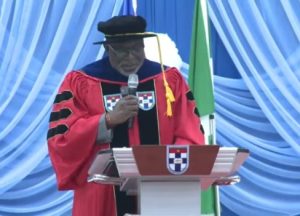
In a striking testament to resilience and vision, the Registrar, African Aviation and Aerospace University (AAAU), Abuja, Dr. Mustapha Sheikh Abdullahi, has revealed how what many once dismissed as an impossible dream has now become one of Africa’s most promising centres of aviation education.
“When I was appointed, I was appointed to nowhere,” he said, reflecting on the university’s turbulent beginnings. “I was only given the name of the university – no concept note, no academic brief, nothing. Ninety-five per cent of the people around me thought it was a joke, even my friends and family. But today, by the grace of God, we have 300-level students and are preparing to graduate our first set by 2027.”
Established under the supervision of Nigeria’s Federal Ministry of Aviation and Aerospace Development, AAAU was conceived as a pan-African centre of excellence to produce world-class professionals for the continent’s aviation industry. But its early days were far from easy.
The Registrar recounted how, in the beginning, the institution had neither offices nor salary structure. “For five months, staff worked without pay because there was no structure, no financial framework, nothing to even determine what we should earn. But we believed in the vision and gave it everything. We told ourselves that if this university failed, our names would fail with it,” he said.
That unyielding commitment has since paid off. Within just three years of academic operation, AAAU has gained national and international recognition, attracting attention from global aviation stakeholders and academic institutions across continents.
From what began as an uncertain venture, the university has now become a rising name in aviation education circles worldwide. “Anywhere you talk about global aviation education today, AAAU is being mentioned,” said Dr Abdullahi proudly.
The university has already signed active Memoranda of Understanding (MoUs) with several international institutions, including the French Civil Aviation University in Toulouse, Gulf Aviation Academy in Bahrain, De Montfort University in the United Kingdom, Coventry University, Cranfield University, and the University College of Aviation in Malaysia. Negotiations are ongoing with RMIT, Swinburne University, and the University of Adelaide in Australia, as well as Embry-Riddle Aeronautical University in Florida, USA.
Locally, AAAU maintains strategic collaborations with key aviation agencies such as the Nigerian Meteorological Agency (NiMet), Nigerian Safety Investigation Bureau (NSIB), Nigerian College of Aviation Technology (NCAT), and the Nigerian Civil Aviation Authority (NCAA).
Dr Abdullahi noted that the NSIB currently provides the university with free facilities and office space – a testament to the industry’s faith in its mission.
“Our relationship with these agencies started as mentorship rather than partnership,” he explained. “They have been supporting and guiding us as we grow into our own identity. Today, we are tapping from their vast repositories of knowledge to strengthen our academic foundation.”
Another major milestone for the young university is its near completion of a permanent campus on a 200-hectare site in Abuja. Following the groundbreaking ceremony on 21 July 2024, led by the Honourable Minister of Aviation and Aerospace Development, construction has progressed rapidly, surpassing expectations.
“As of October 2025, less than a year since actual work began, over seven structures are almost completed,” the Registrar said. “We have facilities you can sleep in today, and internal roads and power lines are near completion. One of our lecture theatres, for Aviation Business Management, will rank among the top five of its kind in Nigeria.”
He added that the university plans to begin phased relocation to the new campus by December 2025, starting with the School of Postgraduate Studies, which boasts 23 en suite offices and is in the final stage of finishing works.
Dr Abdullahi highlighted manpower development as both a challenge and a core mission for the university. “This university exists to solve the manpower gap in Africa’s aviation industry. So, if the challenge persists, it means we are needed,” he said.
AAAU’s pan-African orientation has already begun attracting interest from across the continent, with foreign experts and Nigerian professionals in the diaspora serving as external lecturers. “We have lecturers teaching from Australia, Asia, and America through virtual platforms,” he noted. “For instance, one of the world’s best aviation management experts – a Nigerian based in Australia – has joined us as an external resource person.”
He issued a call to professionals within Nigeria’s aviation system – including those in NiMet, NCAA, and NAMA – to collaborate with AAAU. “Many of these agencies have highly qualified staff with PhDs. We are inviting them to join us in this noble effort to shape the future of aviation education in Africa.”
Reflecting on the institution’s trajectory, the Registrar credited the Ministry of Aviation and Aerospace Development and the University’s Governing Council, chaired by Alhaji Bukar Gumi Tofa, for their unwavering support.
“Our success so far has been possible because the Ministry has respected our autonomy,” he stated. “They have allowed us to implement our policies independently and creatively, and that has given us confidence and freedom to grow. The future is bright – if this continues, the sky will only be our starting point.”
The university recently underwent its first accreditation exercise by the National Universities Commission (NUC), with what the Registrar described as “an excellent performance” in the preliminary report.
As AAAU moves closer to graduating its pioneer students by 2027, Dr Abdullahi said the journey so far has been both humbling and inspiring. “The day we graduate our first students, I think I deserve to wear a graduation gown too,” he joked. “Because truly, we have all grown with this institution – from nothing to something the world is now proud of.”
About The Author