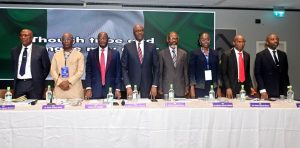


A broad coalition of federal agencies, transport regulators, emergency management institutions and security bodies has endorsed the Federal Government’s new framework placing the Nigerian Safety Investigation Bureau (NSIB) under direct presidential supervision through the Office of the National Security Adviser (ONSA), in what officials described as a major step towards strengthening transportation safety oversight and national emergency coordination.
The endorsement was made during a high-level stakeholder engagement convened in Abuja on Thursday at the Joint Intelligence Board Hall of the ONSA, following the approval granted by President Bola Ahmed Tinubu in March 2026 for a new governance structure for the NSIB.
The reform effectively removes the Bureau from its previous supervisory arrangement under the Federal Ministry of Aviation and Aerospace Development and establishes it as an independent multimodal accident investigation agency reporting directly to the Presidency.
The meeting was chaired by the National Security Adviser, Nuhu Ribadu, while the Special Adviser to the President on Policy and Coordination, Hadiza Bala Usman, served as co-chairperson.
In attendance were representatives of major federal institutions including the Federal Ministry of Justice, Central Bank of Nigeria, Federal Road Safety Corps, Federal Roads Maintenance Agency, Nigerian Railway Corporation, National Inland Waterways Authority, Nigerian Ports Authority, Nigeria Civil Aviation Authority.
Others include Federal Airports Authority of Nigeria, Nigerian Airspace Management Agency, Nigeria Police Force, National Emergency Management Agency, the Armed Forces, Air Command, and other agencies connected to transportation management and public safety.
Participants described the new arrangement as a strategic institutional reform intended to address long-standing coordination gaps in the management of transport accidents and emergencies across the country.
According to stakeholders, transportation incidents in recent years have increasingly revealed the need for closer collaboration between safety investigators, intelligence agencies, emergency responders and infrastructure managers, particularly in situations involving national security implications or large-scale public emergencies.
Director-General of the NSIB, Alex Badeh Jr., said the transition to the Presidency would reinforce the Bureau’s independence and improve the credibility of its investigations.
Badeh explained that the NSIB’s responsibility is centred on identifying the probable causes of accidents and recommending corrective measures aimed at preventing recurrence, rather than assigning blame or carrying out prosecutions.
“Our responsibility remains preventive, not punitive. The Bureau determines probable causes of accidents, identifies systemic safety gaps, and issues recommendations aimed at preventing future occurrences. We do not regulate, prosecute, or apportion blame,” he said.
He noted that the revised framework would help eliminate delays associated with occurrence notifications, evidence gathering and inter-agency coordination, especially during complex investigations involving several institutions.
The NSIB chief recalled that some investigations carried out between late 2025 and early 2026 encountered operational difficulties due to delayed access to information and overlapping jurisdictional responsibilities, adding that the new reporting structure would significantly improve institutional cooperation.
Speaking further, Ribadu stated that the Presidency approved the framework to eliminate bureaucratic bottlenecks and guarantee neutrality in accident investigations.
He said the ONSA would provide strategic oversight and institutional coordination support in cases where investigations involve sector-wide operational failures or agencies directly connected to transportation management.
Ribadu stressed that an independent reporting line was essential to sustaining public trust and ensuring transparency in safety investigations.
He also revealed that plans were underway to amend the NSIB Establishment Act 2022 to reflect the new governance structure, noting that the Office of the Attorney-General of the Federation would constitute a technical committee involving relevant agencies and stakeholders to begin the legislative process.
In her remarks, Hadiza Bala Usman described the reform as part of the Tinubu administration’s wider effort to strengthen governance systems and align Nigeria’s transportation safety architecture with international standards.
She said the framework mirrors globally recognised models such as the National Transportation Safety Board, the Transportation Safety Board of Canada, and France’s Bureau d’Enquêtes et d’Analyses pour la Sécurité de l’Aviation Civile.
The meeting concluded with a series of resolutions, including the development of inter-agency standard operating procedures within 30 days and the establishment of memoranda of understanding among relevant institutions within 60 days.
Stakeholders also agreed to support the legislative amendments required for the smooth implementation of the framework and pledged to deepen collaboration through coordinated response systems and structured institutional partnerships.
The reform represents a significant shift in Nigeria’s approach to accident investigation, with transportation safety now being increasingly viewed as part of a broader national resilience and public accountability framework rather than a purely sectoral responsibility.
About The Author