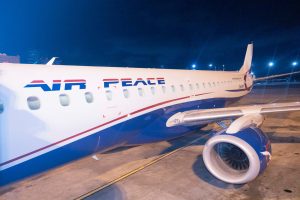

United Nigeria Airlines has unveiled ambitious plans to significantly expand its route network across Africa and into major international markets, with the carrier targeting several West African destinations as part of a broader strategy to transform itself from a predominantly domestic operator into a regional and global airline.
The airline disclosed that it is preparing to commence services to Monrovia, Banjul, Dakar, Abidjan and Conakry in the near future, while also pursuing opportunities in Central Africa, Southern Africa, Europe, North America and the Middle East.
Speaking during a courtesy visit to the secretariat of the League of Airport and Aviation Correspondents (LAAC) in Lagos on Thursday, the Chief Commercial Officer of United Nigeria Airlines, Adedayo Olawuyi, said the carrier’s expansion plans have been buoyed by recent fleet acquisitions and the prospect of additional aircraft deliveries.
He noted that the airline is strategically positioning itself to take advantage of growing demand for air travel and business connectivity within Africa, particularly at a time when regional economic integration initiatives such as the African Continental Free Trade Area (AfCFTA) are creating new opportunities for trade and movement across the continent.
According to Olawuyi, the airline’s immediate focus is on strengthening its presence in West Africa by connecting key commercial and political capitals within the sub-region.
“As you know, we have just acquired some aircraft, and we still have more on the way. Our plan is to grow within the region and also internationally. In the short term, we are looking to increase our presence in West Africa, starting with routes such as Monrovia, Banjul, Dakar, Abidjan and Conakry,” he said.
The airline executive explained that United Nigeria Airlines is also progressing with a previously announced partnership initiative in Guinea-Bissau, where it intends to support efforts to establish a national airline.
He said the project would not only deepen the airline’s influence in the West African aviation market but also contribute to expanding its operational footprint across the region.
“I’m sure you also read about the partnership with Guinea-Bissau, so there are plans for us to set up an airline there, which will help us increase our fleet presence in West Africa,” Olawuyi stated.
Beyond West Africa, the airline is looking to establish services to Douala in Cameroon and Libreville in Gabon as part of its Central African expansion strategy. It is also considering Johannesburg as a gateway into Southern Africa.
According to Olawuyi, commercial and economic opportunities remain the primary drivers behind the airline’s interest in South Africa despite recent concerns affecting travel and diplomatic relations in parts of the continent.
“In Central Africa, we are looking at Douala and Libreville, and further down, at Johannesburg, South Africa. Despite the attacks, we will continue to look at South Africa because it’s about more than the issues happening today; it’s about trade between the two countries,” he said.
The expansion blueprint extends well beyond Africa. Olawuyi revealed that the airline has identified the United Kingdom, the United States, Canada, Turkey, Dubai and Saudi Arabia as strategic international destinations it hopes to serve within the next six to 24 months.
He stressed, however, that the rollout of the routes would depend on several factors, including aircraft availability, regulatory approvals and the acquisition of foreign carrier permits from the relevant authorities.
“We are also looking at the UK, the US, Canada, Turkey, Dubai and Saudi Arabia. So those are the things we have planned for the next six to 24 months in terms of expansion,” he said.
“All of this is subject to aircraft delivery, regulatory approvals, and obtaining foreign operator or foreign carrier permits, depending on the country. But for all of those destinations, we have already started the process, and for some of them, we are already very far along.”
The announcement reflects a growing trend among Nigerian airlines to expand beyond domestic operations and tap into underserved regional and international markets.
Industry stakeholders have repeatedly argued that improved connectivity between African countries remains critical to unlocking the continent’s economic potential.
Despite accounting for a significant share of the world’s population, many African cities remain poorly connected by direct air services, often forcing travellers to transit through hubs outside the continent.
Aviation experts believe that increased route development by indigenous carriers could help address this challenge while supporting trade, tourism and investment flows.
Olawuyi also highlighted the importance of strategic alliances and partnerships in achieving the airline’s long-term objectives, describing collaboration as an essential component of modern airline operations.
“You can’t do anything by yourself. As the African proverb says: if you want to go fast, go alone; if you want to go far, go together. So that’s exactly what we are trying to push,” he remarked.
He disclosed that the airline has already initiated interline partnerships with several domestic and international carriers, although details of the arrangements have not yet been made public.
According to him, such partnerships will enable United Nigeria Airlines to gain access to markets where operating direct services may not initially be commercially viable because of intense competition or limited passenger traffic.
“There are some markets we can’t enter on our own, maybe because of high competition, or because traffic numbers aren’t enough to justify our own direct flight,” he explained.
The airline is also exploring code-share agreements as a means of extending its network reach, particularly on long-haul routes to destinations such as Canada and the United States.
“So we are looking at partnering with a few airlines within the country and across West Africa and the rest of the continent to help fast-track this, as well as for the international destinations,” Olawuyi said.
“Even on routes like Canada and the US, we might start with a code-share before launching our own service. As for other companies in the value chain, if we’re unable to acquire our own aircraft, we can opt for a lease instead, which will also help us achieve our goals faster. So cooperation is definitely one way that will help us achieve our goals.”
Founded in 2021, United Nigeria Airlines has steadily expanded its domestic operations, connecting major Nigerian cities and increasing its market share in the country’s competitive aviation sector.
The latest expansion plans signal the carrier’s intention to emerge as a major player in regional and international aviation, leveraging fleet growth, strategic partnerships and market opportunities across Africa and beyond.
If successfully implemented, the proposed network expansion could significantly enhance Nigeria’s air connectivity, strengthen economic ties with neighbouring countries and provide travellers with more direct travel options across Africa and key global destinations.
About The Author