
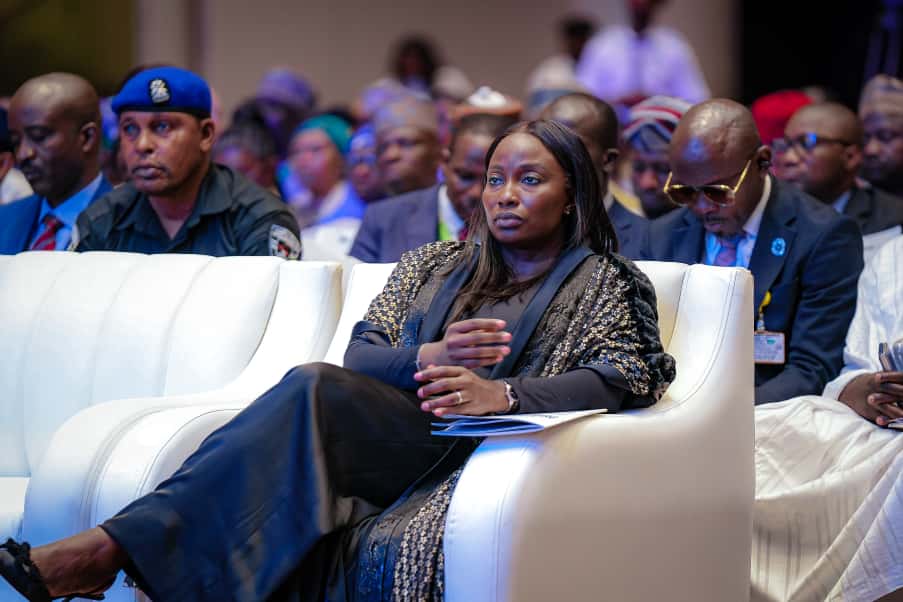
The Managing Director and Chief Executive Officer of the Federal Airports Authority of Nigeria (FAAN), Olubunmi Kuku, has shed light on the Federal Government’s decision to temporarily suspend the full enforcement of a cashless payment policy at Nigerian airports, stating that authorities are adopting a hybrid payment system while strengthening infrastructure and technology to support a seamless transition.
Speaking during an interview with CNBC Africa, Kuku explained that the move followed operational challenges encountered during the early days of implementing the policy, particularly at airport toll gates in Lagos and Abuja.
According to Kuku, FAAN began rolling out the cashless payment initiative in July 2025 and intensified the process in October as part of broader Federal Government reforms aimed at improving transparency, blocking revenue leakages and modernising airport operations.
The policy was designed to eliminate cash transactions at airport revenue points such as toll gates, car parks, and VIP lounges, replacing them with digital payment options including contactless cards, bank ATM cards, e-tags and other electronic channels.
The reform also aligns with the Federal Government’s directive for Ministries, Departments and Agencies to discontinue cash handling in public transactions in order to strengthen accountability and revenue collection.
However, when enforcement began on March 1, 2026, the new system led to significant traffic congestion around major airport access roads, particularly near the toll gate linking the international and domestic terminals of Murtala Muhammed International Airport in Lagos.
The situation prompted intervention from the Nigerian President, Bola Ahmed Tinubu, who directed aviation authorities to temporarily adopt a hybrid payment approach while the system is improved.
Kuku described the decision as a pragmatic step that allows both cash and electronic payment systems to operate simultaneously while FAAN strengthens the necessary infrastructure.
“We are grateful to Mr President for recognising the uniqueness of the airport environment,” she said. “While implementing federal directives, we must also ensure that passengers and commuters have a seamless experience.”
She disclosed that FAAN had already registered over 100,000 users on the contactless payment platform between October 2025 and early March 2026, with about 62,000 registrations occurring within the final three days before enforcement began.
According to her, although the technology functioned effectively, many commuters were not fully prepared for the immediate shift away from cash transactions.
Unique Challenges at Lagos Airport
Kuku explained that airport traffic dynamics differ significantly between Nigeria’s major aviation hubs.
While passengers travelling to Nnamdi Azikiwe International Airport in Abuja typically have the airport as their final destination, the situation in Lagos is more complex because the airport sits within densely populated urban communities.
Motorists often use the airport road corridor as a transit route between areas such as Ikeja, Oshodi and Isolo, leading to heavy traffic around the airport environment.
“These dynamics make Lagos particularly unique compared with many international airports that are located within dedicated aviation zones far away from city traffic,” she explained.
Beyond the payment policy, Kuku emphasised that Nigeria is pursuing a broader strategy to transform its airports into major regional aviation hubs.
She pointed to successful models such as O. R. Tambo International Airport in Johannesburg, Addis Ababa Bole International Airport and Cairo International Airport, which function as major transit centres connecting passengers across continents.
According to her, a hub airport is one that allows travellers to connect seamlessly between international destinations without making the host country their final destination.
To achieve this, she said Nigeria must expand airline connectivity through bilateral air service agreements, strengthen trade and tourism activities, and improve airport infrastructure.
Despite having Africa’s largest population and economy, Nigeria’s passenger traffic remains relatively low compared with its gross domestic product, suggesting significant room for growth in air travel demand.
Kuku also provided an update on the ongoing rehabilitation of facilities at Lagos airport, noting that the project is expected to take between 22 and 24 months.
She disclosed that a temporary terminal has already been constructed within a three-month period to accommodate airlines while renovation works continue.
Several international carriers, including Air France, KLM and Ethiopian Airlines, have relocated their operations to the temporary facility.
Although a major fire incident recently affected some equipment being moved between terminals, Kuku said the impact on operations was minimal and normal activities have since resumed.
Looking ahead, the FAAN chief said the authority is redesigning the passenger journey from the moment travellers approach the airport through to departure and arrival processes.
Planned upgrades include biometric verification systems, electronic gates, improved passenger flow designs, and a dedicated transit facility that will enable international passengers to connect through Nigerian airports more easily.
She stressed that the success of Nigeria’s aviation modernisation agenda will depend not only on infrastructure but also on technology, airline partnerships and improved passenger experience.
“Our goal is to design the airport from the inside out, focusing on how passengers move through the entire journey,” Kuku said.
“We believe that when these reforms are fully implemented, Nigeria’s airports will become more efficient, competitive and capable of serving as major aviation hubs in Africa.”
About The Author