
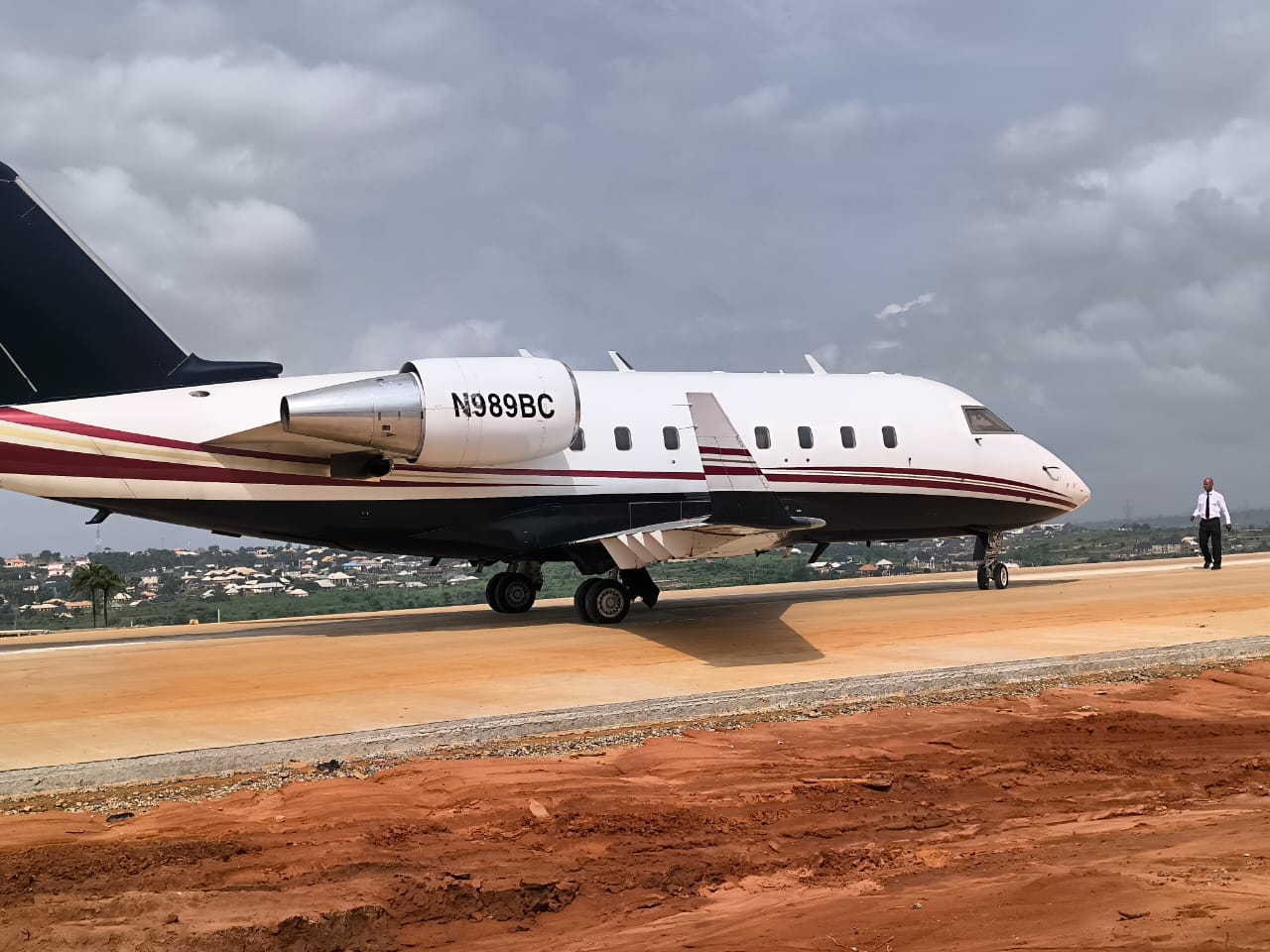
The Nigerian Safety Investigation Bureau (NSIB) has released its preliminary report into the serious incident involving a Bombardier Challenger 601-3A aircraft that mistakenly landed on a paved roadway under construction near Asaba Airport instead of the designated runway, stressing that investigations are still ongoing and that no conclusions have yet been reached on the cause of the occurrence.
The Bureau disclosed this in a statement issued on Thursday by its Director of Public Affairs and Family Assistance, Mrs Funke Adebayo-Arowojobe.
According to the NSIB, the incident occurred on 10 June 2026 during an Instrument Flight Rules (IFR) flight operated by VMO Aero Limited.
The aircraft, bearing nationality and registration marks N989BC, was flying from the Murtala Muhammed International Airport (MMIA), Lagos, to Asaba Airport in Delta State.
The Bureau said that during the approach into Asaba, the crew discontinued the initial landing approach before repositioning the aircraft for a second approach to Runway 11.
It noted that the flight crew reported that the aircraft’s navigation systems indicated that it was correctly established on the published Required Navigation Performance (RNAV) Runway 11 approach. However, the aircraft eventually touched down on a paved roadway that was under construction in the vicinity of the airport rather than on the intended runway.
Despite the unusual landing, all seven occupants on board escaped unhurt. They comprised four crew members and three passengers.
Following the landing, the aircraft was shut down and subjected to an initial inspection while the passengers safely disembarked.
The NSIB stated that after the inspection, the aircraft departed the roadway and successfully returned to Murtala Muhammed International Airport in Lagos without any additional operational abnormalities being reported during the flight.
A subsequent post-flight examination, however, revealed damage to the aircraft’s left nose-wheel assembly.
Providing details of the investigation, the Bureau said the preliminary report was compiled using information obtained from several sources, including statements from the flight crew and witnesses, Air Traffic Control records, operational documents, examination of the aircraft after the occurrence, as well as data retrieved from the aircraft’s Cockpit Voice Recorder (CVR) and Flight Data Recorder (FDR).
According to the agency, both flight recorders were successfully recovered and downloaded at its Transport Safety Laboratory in Abuja, while technical examinations and detailed analysis are continuing.
The NSIB explained that the preliminary report presents only factual information established during the early stages of the investigation, alongside initial findings and immediate safety recommendations aimed at addressing safety concerns identified so far.
It emphasised that the report does not contain any analysis, determination of probable cause or conclusions regarding factors that contributed to the incident.
“The preliminary report contains the factual information established during the investigation to date, including Initial Findings based on the evidence currently available and Immediate Safety Recommendations arising from safety issues identified at this stage of the investigation.
“The report does not include analysis or conclusions regarding the causes or contributing factors associated with the occurrence, as the investigation remains ongoing,” the Bureau stated.
The agency added that it would publish a comprehensive final report upon completion of the investigation in line with the provisions of Annex 13 of the International Civil Aviation Organisation (ICAO) Convention on International Civil Aviation.
The final report, according to the NSIB, will contain detailed analysis of the occurrence, conclusions on the probable causes and contributing factors, as well as additional safety recommendations where necessary.
The Bureau also announced that the preliminary report has been made available on its official website for access by members of the public, aviation stakeholders and the media.
The incident has drawn significant attention within Nigeria’s aviation industry because landing on a surface other than the designated runway is classified internationally as a serious safety occurrence.
Aviation safety experts note that investigations conducted under ICAO Annex 13 are intended not to apportion blame but to identify safety deficiencies and recommend measures that will help prevent similar occurrences in the future.
About The Author