
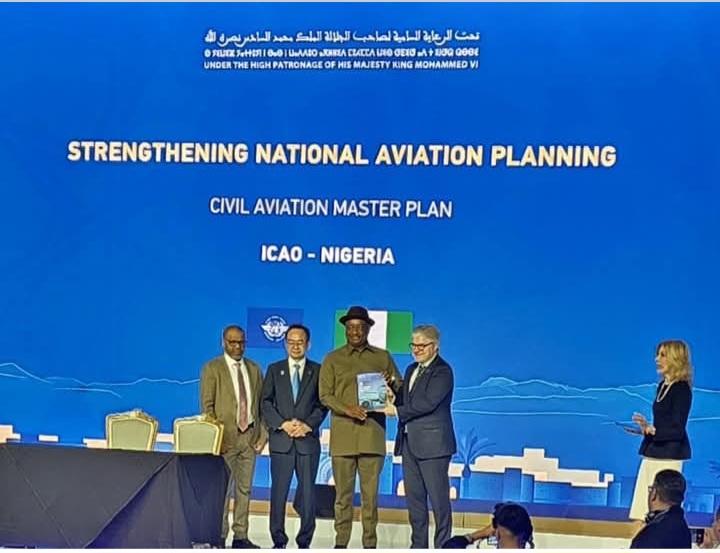
Nigeria has strengthened its ambition to build a world-class aviation sector with the formal handover of its Civil Aviation Master Plan (CAMP) by the International Civil Aviation Organization at a major global gathering in Marrakech, Marrakech.
The comprehensive blueprint was presented today. during the opening session of the ICAO Global Implementation Support Symposium (GISS), where the Honourable Minister of Aviation and Aerospace Development, Festus Keyamo, formally received the document on behalf of the Federal Government.
In addition to the presentation ceremony, the Minister featured prominently at a Ministerial Round Table, where he addressed global stakeholders on the “Future of Aviation Workforce in Nigeria.”
In his remarks, he underscored the urgent need to close the skills gap within the aviation industry, outlining government-driven initiatives aimed at equipping Nigerians with the technical expertise required to sustain sectoral growth.
The CAMP represents a defining milestone for Nigeria’s aviation industry, offering a structured and forward-looking strategy to guide development over a 20-year period from 2025 to 2045.
Carefully aligned with Nigeria’s National Development Plan and other critical policy frameworks, the document ensures that aviation growth is fully integrated into the country’s wider economic and infrastructural agenda.
The journey towards the master plan began in September 2024, following ministerial approval for its development in partnership with ICAO’s Capacity Development and Implementation (CDI) unit.
The process commenced with an intensive capacity-building programme on aviation master planning, bringing together regulators, operators, and other key stakeholders to contribute to a holistic and inclusive framework.
Central to the CAMP is a strong emphasis on infrastructure renewal and technological advancement. The plan outlines strategies for upgrading airport facilities across the country to meet increasing passenger demand and cargo throughput, while also embracing emerging technologies, including the deployment of unmanned aerial systems.
Equally critical is the plan’s focus on safety and security. Nigeria aims to consolidate its record in aviation safety by maintaining strict adherence to international standards, with the long-term objective of sustaining a zero-fatality environment across its airspace.
Beyond infrastructure and safety, the CAMP introduces an economic dimension through the planned development of aerotropolis hubs around major airports. These hubs are expected to serve as catalysts for industrial growth, trade expansion, job creation, and improved connectivity, positioning aviation as a key driver of national development.
The master plan also prioritises sustainability and human capital development. It provides a framework for nurturing a highly skilled workforce capable of meeting the demands of a rapidly evolving aviation landscape.
At the same time, it opens up new investment windows for private sector participation, particularly in specialised areas such as Maintenance, Repair and Overhaul (MRO) services and state-of-the-art cargo logistics facilities.
Environmental sustainability features prominently, with provisions to align Nigeria’s aviation expansion with global climate commitments and eco-friendly practices.
Industry observers note that the international unveiling of the CAMP at the ICAO symposium reflects Nigeria’s growing influence and commitment to global best practices in aviation management and development.
As the apex global aviation body, ICAO’s involvement lends significant credibility to the initiative, reinforcing Nigeria’s resolve to build a safe, efficient, and economically viable aviation sector.
With the master plan now formally in place, attention is expected to shift towards implementation, as stakeholders across the industry align efforts to translate the blueprint into tangible outcomes that will redefine Nigeria’s aviation landscape for decades to come.
About The Author